
Education and Career Guidance
Discover how Presbyterian High School builds character, resilience, and future readiness in students through its CCE programme.
Character and Citizenship Education
Vision
Every PresHighian who places character first and uses it as a compass to guide his or her actions and choices
Approach
With CCE2021, we aim to develop in our PresHighians:
good character
resilience and social-emotional well-being
active citizenship
future readiness.
Guiding Principles for CCE2021 Implementation:
Student-centricity: We place students at the heart of all our efforts in CCE.
Intentionality: We design and carry out programmes and learning experiences within and outside the classroom with intentionality, and we do not leave learning to chance.
Coherence: Via a school-wide approach, we ensure that students are able to connect, transfer and apply their learning across different school contexts and learning experiences.
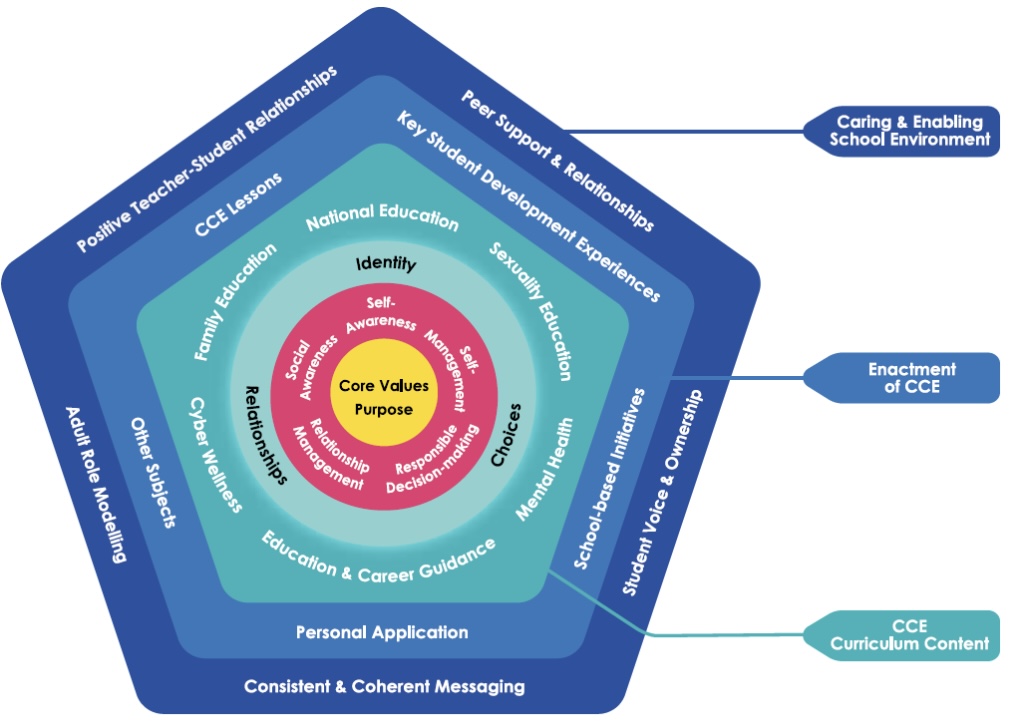
(A) CCE Curriculum Content
The curriculum content of CCE is based on the three big ideas of Identity, Relationships, and Choices. It comprises the teaching and learning of core values, social-emotional competencies and citizenship dispositions, with a focus on developing a sense of purpose in our students. These fundamentals are woven across the following content areas: National Education (NE), Sexuality Education (Sed), Mental Health (MH), Education and Career Guidance (ECG), Cyber Wellness (CW), and Family Education (FE).
(B) Enactment of CCE Curriculum
CCE is enacted intentionally through learning platforms such as Character First (CF) Lessons, key Student Development Experiences (SDEs), school-based initiatives, other subject lessons and learning experiences beyond school.
Key SDEs comprise the following:
TEAM PHS Time;
Chapel and Daily Devotions;
School Assemblies;
Co-Curricular Activities (CCA);
Cohort Learning Journeys (LJs);
Outdoor Adventure Learning (OAL) Cohort Camps;
Education and Career Guidance (ECG) Experiences;
National Education (NE) Experiences;
Student Leadership Development (SLD) Programmes; and
Community Youth Leadership (CYL) Programmes.
(C) Caring and Enabling Environment
A school environment that enables effective CCE is one with adult role-modelling, positive teacher-student relationships, peer support and relationships, student voice and ownership, and consistent and coherent messaging on CCE.
To foster a caring and enabling environment, we seek to understand and address the needs and strengths of each student through multiple touch points, such as TEAM PHS Time and 1-1 chit chats with FTs.